Medieval English Villages You Can Still Visit Today
No English village has been sitting untouched since the Middle Ages. Roofs are replaced, windows change, roads arrive and somebody eventually insists on a broadband cabinet. But there are places where medieval street plans, churches, market crosses, castles and timber-framed houses still shape the experience of walking through them.
What does “medieval village” really mean?
For this guide, we are looking for places where you can still see the medieval village in the streets, church, market place or surviving buildings. Not every cottage is actually medieval, of course, and many churches were altered later. The point is not finding a frozen film set, but a real village where the older shape of the place is still easy to spot.
1. Castle Combe, Wiltshire
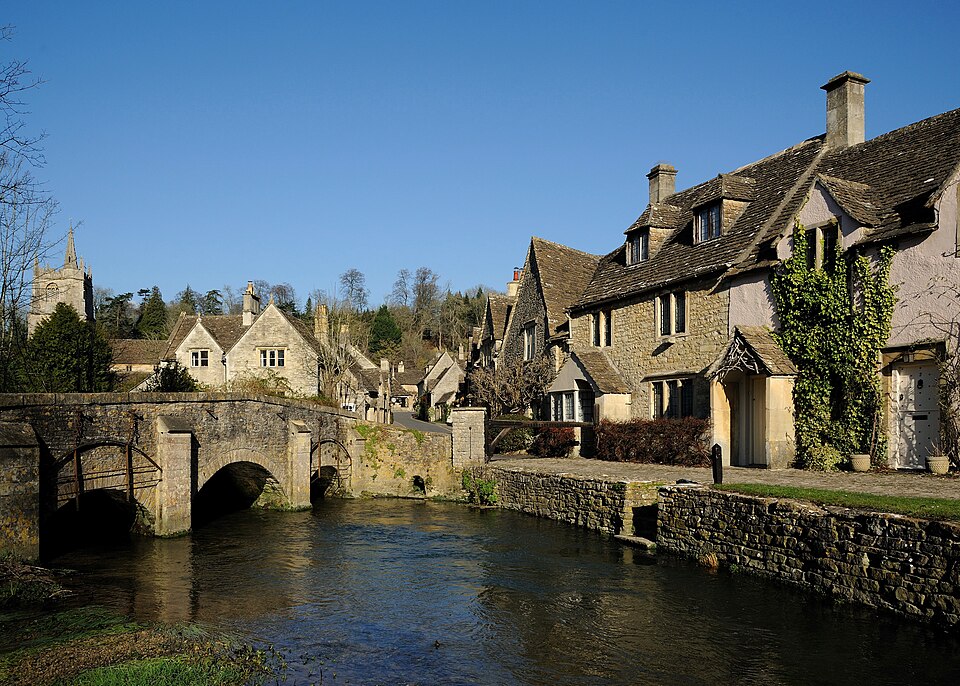
Castle Combe grew around the wool trade and retains a remarkably coherent historic centre. The market cross, St Andrew’s Church and the line of stone cottages descending towards the Bybrook make it one of the easiest places to read as a historic settlement. It also improves considerably once you walk beyond the bridge everyone else is photographing.
Our Castle Combe guide goes beyond the famous bridge view into the church, village history and surrounding walks.
2. Lacock, Wiltshire
Lacock’s historic streets sit beside Lacock Abbey, founded as an Augustinian nunnery in the thirteenth century. The village itself contains buildings from several periods, but its scale, lanes and preserved fabric make it one of England’s strongest places for understanding how a small settlement evolved over centuries rather than being rebuilt wholesale.
3. Lavenham, Suffolk
Lavenham became wealthy through the medieval and early Tudor wool trade, and that prosperity survives in an extraordinary concentration of timber-framed buildings. Strictly speaking it is a village-sized market settlement rather than a tiny rural hamlet, but the Crooked House, Guildhall and church make it impossible to leave out.
4. Dunster, Somerset
Dunster gathers below its castle at the eastern edge of Exmoor. The Yarn Market is later than the medieval period, but the settlement’s castle, church and street pattern reflect a much older market centre. It also works well as a base for walking into Exmoor rather than as a heritage stop viewed through a windscreen.
5. Corfe Castle, Dorset
The village of Corfe Castle sits in the gap of the Purbeck Hills beneath one of England’s most dramatic ruined fortresses. The castle has Saxon associations and a major Norman and later medieval story; the village grew in its shadow. Rambl’s Corfe Castle guide combines the ruins with walking routes around Purbeck.
6. Alfriston, East Sussex
Alfriston’s parish church, old high street and the Clergy House (a rare surviving medieval timber-framed house) give the village a strong historic core. Its position beside the River Cuckmere and below the South Downs means the landscape still explains why the settlement sits where it does.
7. Ightham, Kent
Ightham is a small Kent village whose greatest medieval survivor lies just outside it: Ightham Mote, a moated manor house with origins in the fourteenth century. The wider settlement has evolved, but the combination of old lanes, church and manor landscape makes this a good history-and-walking day.
8. Warkworth, Northumberland
Warkworth is dominated by its castle, a stronghold associated with the Percy family. The medieval bridge, church and long main street reinforce the sense of a settlement shaped around a fortress and crossing point. The River Coquet adds a gentler loop once you have had enough battlements.
9. Castle Acre, Norfolk
Castle Acre is unusually rich for its size: Norman castle earthworks, a surviving bailey gate and the extensive ruins of Castle Acre Priory sit within and beside the village. Few places allow you to move so easily between military, monastic and domestic medieval landscapes.
10. Tissington, Derbyshire
Tissington is better known for later stone houses and its well-dressing tradition, but its church has Norman work and the village’s estate landscape gives a strong sense of continuity. It makes a quieter historic counterpoint to busier Peak District bases such as Bakewell and Castleton.
11. Lacock to Castle Combe: why Wiltshire is so good for this
Wiltshire’s limestone villages, abbeys and market routes make it especially rewarding for this kind of trip. A weekend can combine Lacock, Castle Combe and walks through the surrounding countryside without trying to turn every hour into a checklist.
12. Cartmel, Cumbria
Cartmel Priory began in the twelfth century and still towers above a village whose lanes preserve the scale of a historic settlement. Much of what visitors see is later, but the priory’s survival gives Cartmel an unusually powerful medieval anchor. It is also a useful southern-Lakes base when high fells are not the entire point of the weekend.
How to visit without turning the village into scenery
These are living communities. Use signed parking, keep gateways clear, spend locally where it makes sense and walk rather than repeatedly moving the car between viewpoints. The more famous the village, the more important that becomes.
For more old settlements, browse Rambl’s Villages & Market Towns collection, our broader guide to the best English villages, and the Castles & Ruins hub.