Corfe Castle: History, Walks and Visitor Guide
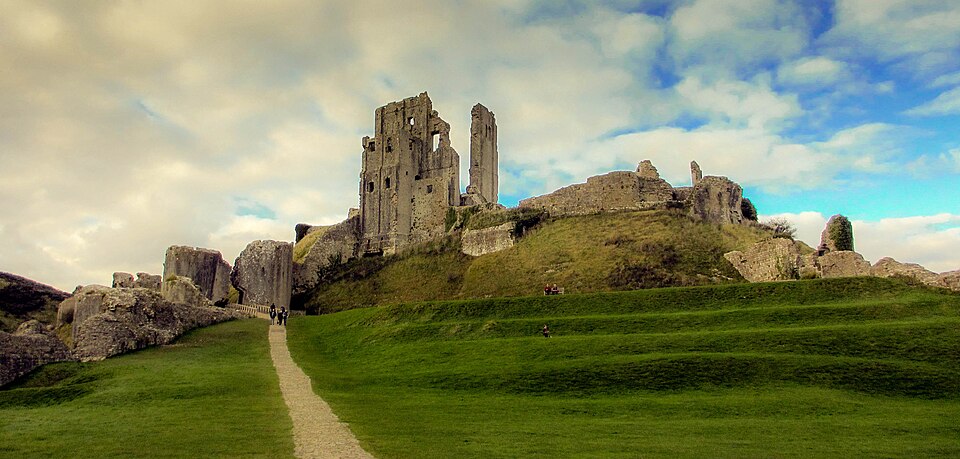
Corfe Castle rises above a gap in the Purbeck Hills like the remains of something considerably larger than the village below, which, of course, it is. The ruins combine royal ambition, Civil War destruction and one of Dorset’s finest settings, with excellent walks beginning almost at the gate.
Corfe Castle at a glance
| Location | Isle of Purbeck, Dorset |
|---|---|
| Origins | Royal castle developed after the Norman Conquest |
| Famous for | Royal stronghold and Civil War sieges |
| Managed by | National Trust |
| Allow | Two hours for the ruins; half a day with the village |
A brief history of Corfe Castle
The ridge was strategically important long before the surviving stone castle. The name Corfe derives from an Old English word for a cutting or gap, describing the natural break through the chalk hills. Whoever controlled that gap could watch movement across Purbeck.
Edward the Martyr was killed at Corfe in 978, traditionally near a royal residence on the site. The precise circumstances became wrapped in medieval storytelling, but the murder helped give the place significance before the Norman castle took shape. Medieval politics was rarely accused of being dull.
William the Conqueror established a castle here after 1066. Unusually for an early Norman stronghold, important parts were built in stone rather than relying entirely on earth and timber. Henry I later commissioned the great stone keep, asserting royal power in a form nobody approaching through the valley could politely overlook.
Royal fortress, prison and treasure house
Successive monarchs expanded Corfe. King John used it as a residence, treasury and prison, and the castle developed formidable walls, towers and gatehouses. Its position and construction made it one of the strongest royal fortresses in southern England.
Corfe was not simply a battlefield structure. It contained domestic apartments, halls, chapels and service buildings required by the royal household. Look beyond the dramatic broken towers and the ruins begin to describe an administrative and residential centre as well as a defence.
The Civil War sieges
By the 17th century Corfe belonged to Sir John Bankes, Attorney General to Charles I. During the English Civil War, Lady Mary Bankes defended the Royalist castle while her husband was absent. Parliamentary forces failed to take it during the first siege in 1643.
A second siege in 1645–46 ended after attackers gained entry with help from inside the garrison. Parliament ordered the castle slighted, deliberately damaged so it could not be defended again. Explosives and dismantling left the leaning walls and fractured towers visible today.
The ruins later returned to the Bankes family and eventually passed to the National Trust with the Kingston Lacy estate in the 20th century.
What to look for inside the ruins
The keep
The remains of the Norman keep still dominate the hill. Its height, pale stone and surviving architectural details hint at the authority the building projected in the 12th century.
The gatehouses
Multiple defensive entrances controlled movement through the castle. Their distorted masonry is particularly striking: sections displaced during the slighting remain at improbable angles, a permanent demonstration that gunpowder rarely improves symmetry.
Views across Purbeck
The upper ruins overlook the village, Poole Harbour and the long chalk ridge. Visibility depends on weather, but even a grey day makes the castle’s strategic position obvious.
Best walks around Corfe Castle
Corfe Common
A shorter route crosses Corfe Common south of the village, giving changing views back towards the ruins. The common contains unimproved grassland and archaeological earthworks, so keep to established paths and follow seasonal livestock guidance.
The Purbeck Ridge
For a longer walk, climb onto the ridge towards Old Harry Rocks or head west towards Creech and the Purbeck countryside. The elevated path offers wide coastal and heathland views, but it is exposed in wind and summer sun.
From Swanage by steam railway
The heritage railway between Swanage and Norden makes a car-free visit possible when services are operating. Arriving beneath the castle by steam train also feels pleasingly appropriate, even if the Normans failed to provide through-ticketing.
Exploring Corfe village
The village contains stone cottages, a parish church, pubs, tearooms and a small museum. Its lanes and buildings are attractive, but Corfe is a living community rather than an extension of the visitor attraction. Park considerately and avoid blocking doorways while composing the definitive cottage photograph.
Allow time to see the castle from below. The view from the village and nearby paths often communicates its scale better than standing directly beneath the walls.
When should you visit?
Spring and autumn suit the ridge walks, with cooler temperatures and softer light. Summer brings longer opening hours and the busiest crowds. Winter can be atmospheric, but high winds, heavy rain or conservation work may affect access.
Visit early in the day for quieter ruins. Opening hours, admission and events change seasonally, so check the official National Trust page before travelling rather than relying on an old screenshot preserved somewhere in your phone.
Practical tips
- Wear footwear suitable for steep, uneven stone and grass.
- Expect exposed sections and limited shelter inside the ruins.
- Check train and bus times if visiting without a car.
- Combine the castle with one walk instead of attempting every Purbeck landmark.
- Keep children supervised around drops and historic masonry.
Discover more of historic Britain
Explore castles, abbeys, old villages and the landscapes around them through Rambl’s growing countryside collection.
Explore castles and ruins