Castle Combe: Things to Do, Walks and Places to Stay
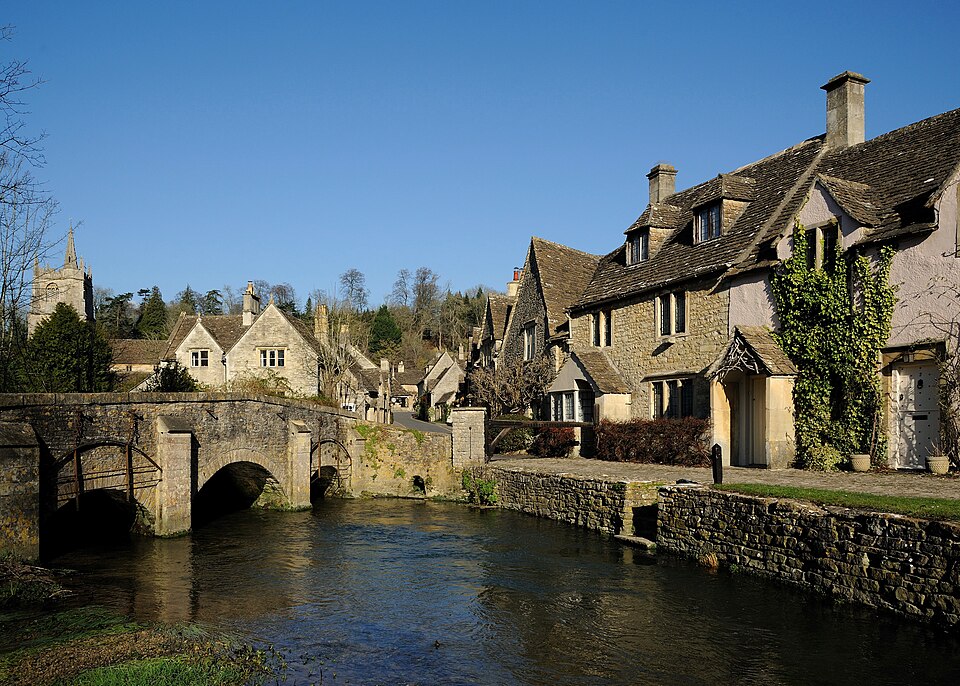
Castle Combe is a small Wiltshire village of honey-coloured stone cottages, a medieval market cross and wooded valley scenery. Its reputation attracts plenty of day visitors, but staying longer reveals footpaths, church history and quieter lanes beyond the familiar bridge photograph.
Castle Combe at a glance
| County | Wiltshire |
|---|---|
| Best for | Historic architecture and countryside walks |
| Allow | Half a day; overnight for a quieter visit |
| Nearby towns | Chippenham, Corsham and Bath |
| Without a car | Possible with advance bus or taxi planning |
Why is Castle Combe famous?
The village grew through medieval wool production and cloth-making, using water from the Bybrook. Its historic centre contains stone houses built in a consistent local material, with few intrusive modern features.
Film and television appearances have strengthened its reputation as an almost improbably English village. That description is not entirely unfair, though residents presumably experience the ordinary business of bins, deliveries and broadband like everybody else.
Castle Combe has no surviving castle, which does feel like a small piece of historical false advertising. The name relates to a former fortification above the village, while “combe” describes the valley setting.
1. Walk through the historic centre
Begin near the market cross and old water pump, then follow the main street downhill towards the bridge. The most photographed view looks back towards cottages rising along the lane.
Take time to notice rooflines, doorways and the way buildings follow the narrow valley. Avoid standing in the road or treating private doorsteps as posing platforms. The village looks better when visitors behave as though people live there, because they do.
2. Visit St Andrew’s Church
St Andrew’s contains medieval fabric and monuments linked with local families. Its tower and churchyard form an important part of the village skyline.
Among the church’s notable objects is a medieval clock traditionally described as one of the oldest working clocks in the country, though claims about exact rankings depend on definitions and later alterations. Treat the church as an active place of worship and check whether services or private events are taking place.
3. See the medieval market cross
The market cross reflects Castle Combe’s historic right to hold a market and its connection with the local wool trade. It stands at the centre of the upper village beside the old pump.
This is a compact feature rather than an attraction requiring an hour, but it helps explain why the settlement developed and where commercial life once gathered.
4. Walk the Castle Combe countryside circuit
Public footpaths climb from the village into woods, fields and the wider Bybrook valley. Circular routes vary, but many use a mixture of lanes, woodland tracks and field paths before returning through the historic centre.
Expect mud after rain and carry an up-to-date map. Woodland paths can be slippery, while working farmland requires gates to be closed and dogs kept under control.
5. Follow the Bybrook valley
The Bybrook once powered mills connected with the local cloth industry. A walk beside or above the valley gives a better understanding of why the village developed here, rather than merely supplying another angle on the cottages.
Not every stretch of water is publicly accessible. Use signed rights of way and do not assume a path continues through private hotel or residential grounds.
6. Explore nearby Lacock
Lacock lies within easy reach and offers preserved streets, a medieval abbey later converted into a country house, and the Fox Talbot Museum’s connection with photographic history.
Combining Castle Combe and Lacock creates a strong heritage day, but both are busy at peak times. An overnight stay allows one village early in the morning and the other later, after the largest groups have departed.
7. Visit Corsham
Corsham provides a larger historic centre, almshouses and Corsham Court, whose opening arrangements are limited and seasonal. Peacocks are a familiar sight around the town, moving with the relaxed authority of creatures aware nobody will challenge their parking.
Corsham also offers more practical accommodation, food and transport than Castle Combe itself.
Where to eat
The village has pubs, tearooms and hotel dining, but choice is limited and opening hours can change outside summer. Reserve dinner if staying overnight, particularly at weekends.
Chippenham and Corsham provide broader alternatives. Check current menus directly rather than travelling for a recommendation that was accurate three landlords ago.
Where to stay in Castle Combe
Accommodation ranges from luxury rooms in and around the Manor House to inns, cottages and rural properties nearby. Staying inside the village costs more but gives you the centre before and after day-trip hours.
For better value, compare Corsham, Chippenham and surrounding Cotswold villages. Location materially changes the experience: the ability to walk out early is worth more than a decorative cushion labelled “country”.
Find a cottage near Castle Combe
If you would rather make a weekend of it, you can compare self-catering cottages and other UK stays through Snaptrip.
Browse stays on SnaptripAffiliate link: Rambl may earn a commission if you book through this link, at no extra cost to you.
When should you visit?
Spring brings fresh woodland and longer days. Summer is attractive but busiest. Autumn suits valley walks and warm stone particularly well, while winter can be quiet and atmospheric when businesses remain open.
Visit on a weekday or before 10am where possible. Rain is not disastrous (the stone darkens attractively) but paths become muddy and the village offers limited indoor shelter unless you have booked somewhere.
Getting there without a car
Chippenham is the nearest useful railway station. Onward buses are limited and routes may not run at convenient times, so check current timetables and taxi availability before travelling.
A taxi in one direction combined with a planned walk or bus can work, but do not assume mobile reception and instant ride-hailing will rescue an improvised return.
Find more beautiful English villages
Explore stone villages, market towns and countryside-break ideas through Rambl’s expanding guide to rural Britain.
Explore English villagesEnjoying Rambl?
Rambl is maintained by one person alongside a full-time job. If the site has helped you plan a walk, find somewhere new or simply given you a good read, you can help support it with a coffee.
No pressure. Reading and sharing Rambl helps too.