Holy Trinity Church, Blythburgh: History and Black Shuck
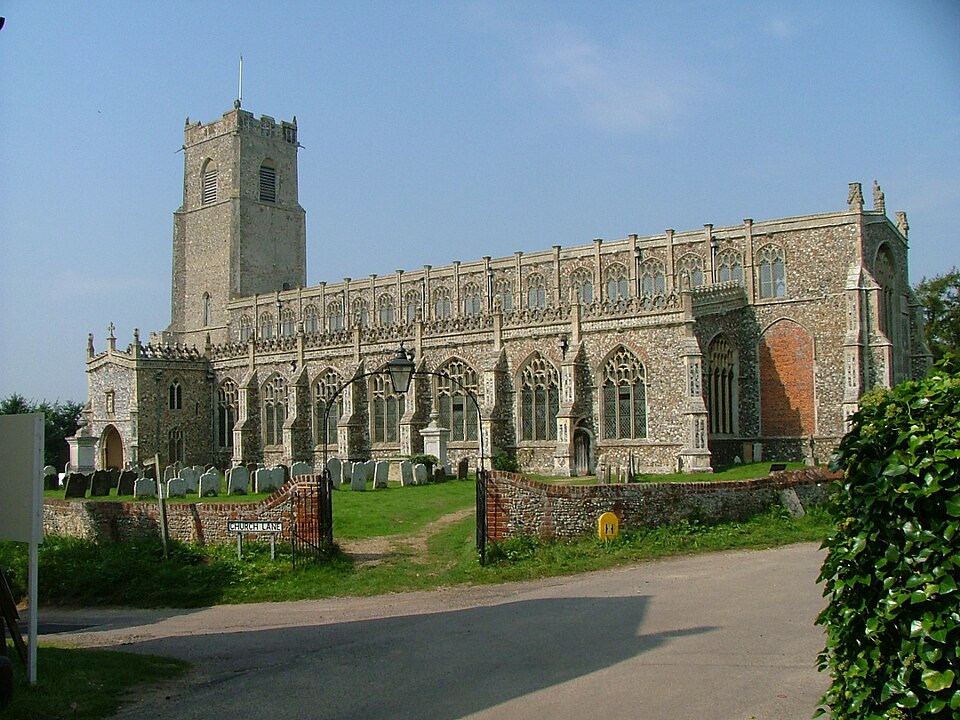
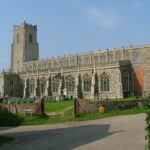
Holy Trinity Church at Blythburgh rises above the Suffolk marshes with the scale and light of a much larger town church. Its medieval roof angels are reason enough to visit; the legend of Black Shuck, supposedly bursting through the church during a storm in 1577, adds a darker second history.
Holy Trinity at a glance
| Location | Blythburgh, Suffolk |
|---|---|
| Known as | The Cathedral of the Marshes |
| Architecture | Principally 15th-century Perpendicular Gothic |
| Famous feature | Hammer-beam roof with carved angels |
| Folklore | Black Shuck and the storm of 1577 |
Why is Blythburgh church so large?
Blythburgh was more important in the medieval period than its present size suggests. It stood near navigable water and participated in the trading economy of the Suffolk coast. Wealth from local land, livestock and commerce helped fund an ambitious parish church.
Most of the building you see today dates from the 15th century. The tall windows let huge amounts of light into the wide nave, while the timber roof above is where the church really starts showing off.
The angels in the roof
Carved angels line the hammer beams high above the nave. Medieval carpenters were not known for doing things by halves here. In a medieval church, the roof, painted images, screens and worship were all meant to work together, rather than being separate things you politely admire one by one.
Reformation-era iconoclasm damaged many church images across England. Blythburgh’s angels survive despite signs of deliberate damage, making the roof both beautiful and historically revealing.
The medieval interior
Look for the font, screens, benches and traces of changing decoration. Parish churches were repeatedly adapted: new worship practices, monuments, repairs and restorations altered interiors without erasing every earlier layer.
The light is one of the building’s strongest qualities. Move through the nave slowly rather than inspecting it as a checklist of objects. The space itself was designed to affect people.
What happened in the storm of 1577?
On 4 August 1577, a severe storm struck parts of Suffolk. A contemporary pamphlet by Abraham Fleming described extraordinary events at churches in Bungay and Blythburgh, including deaths, injuries and damage.
At Bungay, Fleming described a frightening black dog appearing during the storm. The episode later became central to East Anglian Black Shuck folklore. Accounts of Blythburgh are often folded into the same story, with scorch marks on the north door popularly identified as the creature’s claw marks.
Lightning, fire and structural damage provide natural explanations for the physical marks and chaos. The historical storm is documented; the supernatural dog belongs to folklore. Both are worth understanding, but they are not the same kind of evidence.
The Black Shuck legend
Black Shuck is the name commonly given to a spectral black dog said to roam East Anglia’s roads, coasts and churchyards. Stories vary: the animal may be an omen, a terrifying pursuer or simply a strange presence glimpsed at night.
The name, distribution and details developed over time. It is misleading to present one fixed ancient legend stretching unchanged from prehistory. Read Rambl’s full Black Shuck history for the documented sources and later retellings.
The church in the landscape
Holy Trinity stands above the River Blyth estuary and surrounding marsh. Its tower can be seen across the flat landscape, demonstrating why parish churches served as navigational and communal landmarks as well as places of worship.
Nearby paths and nature reserves make Blythburgh suitable for a slower day combining church, landscape and birdlife. Use current rights-of-way maps and observe seasonal restrictions.
What else is nearby?
Southwold
The coastal town of Southwold lies a short distance east, with a pier, lighthouse, beach and historic centre. It has the broadest choice of accommodation and food nearby.
Walberswick
Walberswick offers dunes, marsh paths and access across the River Blyth towards Southwold. Ferries and seasonal services vary, so check before relying on them.
Dunwich
Dunwich’s much-reduced village and eroding coast preserve the memory of a medieval port largely lost to the sea. Museum hours and coastal conditions require checking.
Visiting respectfully
- Remember that Holy Trinity is an active Christian church.
- Check for services, funerals or private events before entering.
- Keep voices low and phones silent.
- Do not touch carvings or attempt to inspect door marks with equipment.
- Leave a donation towards the building’s upkeep.
- Close doors and gates as requested.
When to visit
Long summer evenings suit the marsh landscape, while autumn gives lower light and migrating birds. A stormy day may feel appropriately atmospheric, but standing beneath trees or on exposed marsh during lightning is not an authentic historical experience anybody needs to recreate.
Church opening arrangements can change. Check the parish’s current information before making a special journey.
If this is your sort of day out, continue with Rambl’s guide to the most beautiful churches in the English countryside, explore the best ruined abbeys to visit in England, or go deeper into strange local traditions with 21 British folklore creatures and where their stories come from.
Meet the Black Shuck legend
Trace East Anglia’s spectral black dog through historical sources, church stories and later folklore.
Read the full story