Ancient Stone Circles in Northern England
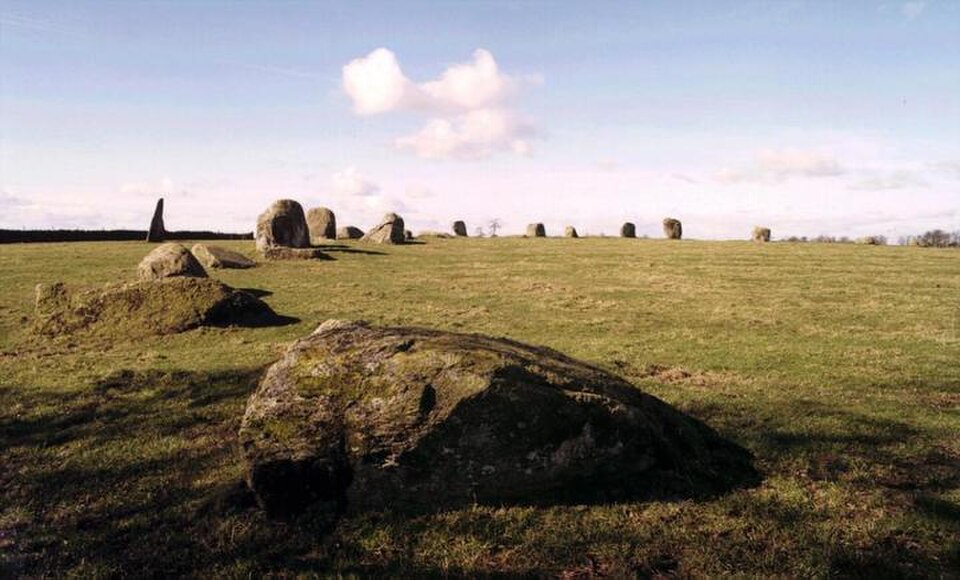
Northern England’s ancient stone circles stand on moorland, farmland and open fell beneath some of the country’s finest horizons. Their builders left no convenient explanatory plaques, but archaeology can still tell us far more than the usual fog of druids, ley lines and confidently invented sacrifice.
Quick picks
| Stone circle | Best for | Area |
|---|---|---|
| Castlerigg | Mountain setting | Lake District |
| Long Meg and Her Daughters | Scale and folklore | Eden Valley |
| Swinside | Atmosphere and seclusion | South-west Cumbria |
| Arbor Low | Earthworks and fallen stones | Peak District |
| Twelve Apostles | A moorland walk | West Yorkshire |
Who built Britain’s stone circles?
Most stone circles were built during the later Neolithic and early Bronze Age, roughly between 3000 and 1500 BC, although every site is different. The people who built them were farming communities with skilled builders, long-distance connections and traditions we can only partly reconstruct today.
Archaeologists consider possible roles in gathering, ritual, burial, seasonal observance and the organisation of landscape. Some monuments have astronomical alignments, but sweeping claims that every stone precisely predicted celestial events usually exceed the evidence. Prehistory is mysterious enough without making every boulder run its own observatory.
The circles pre-date the historical druids described by Roman writers by many centuries. Modern Druid groups may value and use these places, but they did not build them.
1. Castlerigg Stone Circle, Cumbria
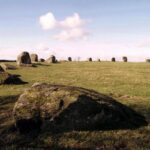
Castlerigg stands on a plateau above Keswick, surrounded by Blencathra, Skiddaw and the central fells. Its dramatic location has made it one of Britain’s most photographed prehistoric monuments.
The circle contains an unusual rectangular arrangement of stones within its ring. Its original purpose remains uncertain, and proposed connections with stone-tool exchange or astronomical observation should be presented as interpretations rather than settled fact.
Access is relatively straightforward from nearby roads or on foot from Keswick. The ground can be wet, the site is exposed and parking is limited. Visit early for quiet, mist or low light, though ordering all three simultaneously is beyond Rambl’s present authority.
2. Long Meg and Her Daughters, Cumbria
Long Meg and Her Daughters is one of England’s largest stone circles. Dozens of rhyolite stones form an enormous oval, while the taller Long Meg monolith stands outside the ring and bears prehistoric rock art.
Folklore claims the stones were witches turned to stone for profaning the Sabbath, and that they cannot be counted accurately. The legend is much younger than the monument but forms part of its later cultural history. Read the full story in Long Meg and Her Daughters.
The circle lies within farmland. Follow the signed access, avoid obstructing lanes and treat crops, livestock and field boundaries with respect.
3. Swinside Stone Circle, Cumbria
Swinside (sometimes called Sunkenkirk) stands near Black Combe in south-west Cumbria. Many stones remain in a clear ring, creating a remarkably complete impression despite the monument’s age.
Its secluded setting is part of the appeal, but access involves walking through working farmland. The circle has its own folklore of failed church-building, in which supernatural forces repeatedly moved stones intended for a church. Similar legends occur at ancient sites elsewhere, suggesting later communities were explaining monuments whose original purpose had long been forgotten.
4. Arbor Low, Derbyshire
Arbor Low is a Neolithic henge monument surrounded by an earth bank and ditch, with a ring of large stones now lying flat. It is often called the Stonehenge of the North, a comparison that attracts attention while concealing how different the site actually is.
The broad Peak District plateau gives the monument a powerful setting. Nearby stands the Bronze Age barrow known as Gib Hill. Access crosses private farmland and normally involves a small charge; check current arrangements and close gates.
5. The Twelve Apostles, Ilkley Moor
This small circle stands on Burley Moor, part of the wider Ilkley Moor landscape. The surviving stones are modest compared with Castlerigg or Long Meg, but the exposed position and surrounding archaeology make it a rewarding walking destination.
Moorland weather changes quickly and paths can be boggy. Use a map, carry layers and avoid relying on the circle itself as a navigational landmark in mist.
6. Gamelands Stone Circle, Cumbria
Gamelands lies near Orton in the gentle limestone country east of the Lake District. Its stones are generally low and the circle is less visually imposing than the famous Cumbrian sites, but that makes it useful for understanding the variety of prehistoric monuments.
The surrounding landscape includes limestone pavement, old tracks and other archaeological features. Approach by public rights of way and remember that low stones are particularly vulnerable to vehicles, fires and careless rearrangement.
7. The Cockpit, Cumbria
The Cockpit is a stone circle on Moor Divock above Ullswater. Reaching it forms part of a rewarding moorland walk, often from Askham or Pooley Bridge, through a landscape containing cairns, standing stones and other prehistoric remains.
The monument is less complete than Castlerigg, but its wider setting matters. Prehistoric landscapes were not collections of isolated pins on a modern map; monuments related to routes, water, hills and one another.
8. Burnmoor stone circles, Lake District
Burnmoor above Eskdale has several prehistoric stone circles and burial cairns scattered across open moorland. Together they form one of Cumbria’s largest groups of ancient monuments, and the empty setting is a large part of what makes the place feel special.
The remoteness demands preparation. Paths may be indistinct, the ground is boggy and visibility can deteriorate quickly. Carry a map and compass and choose settled weather. This is not the place to discover that a screenshot stops being useful when the battery does.
How to visit ancient sites responsibly
- Use public rights of way and follow landowner signs.
- Never move, climb or lean equipment against stones.
- Do not light fires or leave offerings that become litter.
- Keep dogs controlled around livestock and nesting birds.
- Avoid creating new paths across fragile ground.
- Report damage to the relevant heritage authority rather than attempting repairs.
Stone circles, folklore and honest uncertainty
Ancient monuments attract stories because their original meanings were lost. Legends of petrified dancers, impossible counting and supernatural builders are culturally valuable, but they are not archaeological explanations.
Rambl treats the two strands separately: what excavations, dating and landscape study suggest; and what later generations imagined. The uncertainty is not a weakness. A place can remain mysterious without requiring us to manufacture an answer.
For a wider journey through prehistoric England, including hill figures, henges, burial monuments and standing stones beyond the north, see Ancient Sites in England Beyond Stonehenge. You can also browse the Ancient Places & Folklore hub for the history and later stories attached to these landscapes.
Explore Britain’s ancient places
Discover stone circles, old paths and the legends attached to real landscapes through Rambl’s history and folklore collection.
Explore ancient Britain