The Green Children of Woolpit
Two children walked out of the Suffolk countryside with green skin, strange clothes and absolutely no interest in anything except broad beans.
Medieval England was not short of odd stories. Saints floated, devils appeared at inconvenient moments, and almost every sufficiently old hill eventually acquired a giant. Even by those standards, the Green Children of Woolpit are unusually difficult to file away.
Sometime in the 12th century, villagers near Woolpit in Suffolk were said to have found a young brother and sister beside one of the pits outside the village. The children looked human, but their skin was green. They wore unfamiliar clothes, spoke a language nobody understood and refused every bit of food they were offered.
Then somebody brought in broad beans.
At which point the mysterious visitors from another world apparently decided medieval Suffolk was worth giving a chance.
At a Glance
- Where: Woolpit, Suffolk, between Bury St Edmunds and Stowmarket
- When: Sometime in the 12th century
- Sources: Medieval chroniclers William of Newburgh and Ralph of Coggeshall
- Strangest detail: The children reportedly had green skin and initially ate only raw broad beans
- Best explanation: Nobody knows. Lost children, illness, Flemish refugees and folklore have all been suggested
What Was Supposed to Have Happened?
The story begins at harvest time. Labourers working near Woolpit came across two children, a boy and a girl, close to the excavations or pits associated with the village. They were frightened, confused and completely unintelligible to the people who found them.
Their clothes were described as being made from an unfamiliar material or cut in an unfamiliar way. More noticeably, both children were green.
Not slightly peaky. Not unfortunate candlelight. Green.
According to Ralph of Coggeshall, the children were taken to the household of a local knight, Richard de Calne, at nearby Wykes. Food was placed in front of them, but they refused it. Bread, meat and the ordinary medieval options apparently got nowhere. They were hungry enough to become distressed, but still would not eat.
Then freshly cut broad beans appeared. The children grabbed at them eagerly. One version says they first searched inside the stalks rather than the pods and became upset when they found nothing there, until somebody showed them where the beans actually were.
For a while, beans were almost all the pair would eat. Eventually they began accepting other food, and as their diet changed, so did their colour. The green tint gradually disappeared.
The boy was the weaker of the two. He became ill and died not long after the children were taken in, around the time they were baptised. The girl survived, learned English and was finally able to explain where they had come from.
St Martin’s Land
This is where an already odd story wanders cheerfully off the road.
The surviving girl said that she and her brother came from a place sometimes called St Martin’s Land. It was a country where the sun did not shine as it did in England. Instead, everything existed in a kind of permanent twilight. In one account, the people and the landscape there were green too.
The children had apparently been tending cattle when they heard bells. One version says the sound resembled the bells of Bury St Edmunds. Another says they followed their animals into a cave or passage and eventually emerged into the bright light of the English countryside.
They tried to find their way back, but could not.
If you wanted to design a medieval fairy story from scratch, you would struggle to improve it. Strange underground country, dim light, bells in the distance, children crossing unknowingly into another world. It has almost every ingredient except a warning not to eat anything, which is unfortunate because they immediately spent several days demanding beans.
Why the Story Is Hard to Dismiss Completely
The Green Children are often presented online as though somebody discovered the tale in a Victorian book of ghost stories. The awkward bit is that the story is much older than that.
Two medieval writers recorded versions of it: William of Newburgh and Ralph of Coggeshall. Their accounts differ in places, but the central details are remarkably similar. Green skin. Unknown language. Strange clothing. Refusal of ordinary food. Broad beans. The boy dying. The girl surviving and describing another land.
That does not mean the story happened exactly as written. Medieval chroniclers were perfectly capable of recording wonders, rumours and religious stories alongside ordinary history. Neither surviving account is a modern police statement, and neither gives us the sort of evidence anyone would now want before announcing the discovery of an underground green civilisation beneath Suffolk.
But it does suggest that the story was circulating surprisingly close to the time it was supposed to have happened.
Were They Flemish Refugees?
One of the most popular modern explanations is that the children were not supernatural at all, but lost Flemish children.
Eastern England had communities of Flemish settlers during the 12th century. The region also saw serious unrest, including the Battle of Fornham in 1173, when forces that included Flemish mercenaries were defeated near Bury St Edmunds.
Under this theory, the children may have been separated from their family during violence or upheaval. Their unfamiliar language could have been Flemish. Their odd clothes would then have been foreign rather than otherworldly. St Martin’s Land has even been connected by some writers with Fornham St Martin.
It is a neat explanation. Possibly a little too neat.
The dating does not line up perfectly across the medieval accounts, and the link to a particular Flemish settlement is a later reconstruction rather than something the chroniclers themselves tell us. It may be right, but it remains a theory.
What About the Green Skin?
The least supernatural part of the whole story may actually be the bit everyone remembers.
Poor nutrition and certain forms of anaemia can give skin an unusually pale, yellowish or greenish cast. Historically, the term “green sickness” was used for chlorosis, a condition associated with iron deficiency. If two frightened, underfed children had been wandering for some time before being found, their appearance could have been striking enough to become exaggerated in retelling.
The fact that the girl’s colour reportedly faded once she began eating a broader diet makes a nutritional explanation tempting.
It does not explain the unknown language, the strange clothes, the twilight country or the underground route. Then again, those are exactly the details most likely to grow legs once a story has spent a few decades travelling around medieval England.
The boy’s death also suggests that whatever had happened before the children arrived, at least one of them may genuinely have been in poor health.
What Happened to the Girl?
After learning English, the surviving girl appears to have remained in England. Ralph says she served in Richard de Calne’s household for years. William of Newburgh says she later married a man from King’s Lynn and was still alive not long before he wrote his account.
Later writers have tried to identify her more precisely, including claims that she may have been called Agnes and married a royal official. Those identifications are much less secure than the medieval core of the story, so it is safer not to hand her a full modern biography on the strength of a clever bit of detective work.
What matters is that the earliest versions do not end with the girl vanishing back into fairyland. She stays.
Which might actually be the strangest part.
Woolpit Today
Woolpit is still very much a real Suffolk village, and the Green Children remain part of its identity. They appear on the village sign, a wonderfully understated way of saying, “Yes, two green children allegedly emerged from the ground here, anyway the post office is over there.”
The village name itself is old. It appears in medieval forms long before Suffolk became famous for wool, and is commonly linked with pits used for trapping wolves, although local history also records competing explanations for the name.
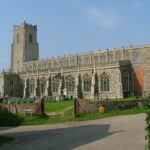
St Mary’s Church stands at the centre of the village, and Woolpit makes an easy addition to a wider Suffolk trip. If you’re already exploring East Anglia’s stranger stories, it pairs particularly well with our piece on Black Shuck, Suffolk’s considerably less approachable supernatural resident.
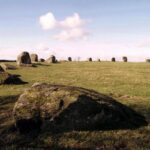
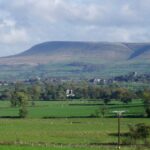
For something further north, Long Meg and Her Daughters involves a Cumbrian stone circle, an angry wizard and a group of witches with an extremely permanent disciplinary problem. And if you prefer folklore where the real history is darker than the legend, the Pendle Witches is the one to read next.
So What Were the Green Children?
Probably not visitors from another planet. Probably not residents of a literal underground kingdom either.
Lost foreign children are possible. Illness could explain the colour. The language barrier and strange clothing could have made them seem much more alien to an isolated medieval community than they would today. From there, a frightening but ordinary event could easily have become a story about crossing between worlds.
But nobody can prove that version either.
And that is why the Green Children have lasted for more than eight centuries. Unlike a ghost story where everything disappears conveniently into fog, there is a stubborn little historical core here. Two respected medieval chroniclers thought the tale worth recording. They agreed on a surprising number of details. One of the children, according to the story, grew up and lived among ordinary English people.
Maybe Woolpit briefly received two frightened children from a neighbouring culture nobody recognised. Maybe generations of retelling turned sickly skin into bright green and a foreign village into another world.
Or perhaps there really is a twilight country somewhere beneath Suffolk where everyone is green and the national cuisine consists almost entirely of broad beans.
In which case, frankly, remaining undiscovered may be the least of its problems.
FAQs
Were the Green Children of Woolpit real?
We cannot know for certain. The story was recorded by two medieval chroniclers, William of Newburgh and Ralph of Coggeshall, which gives it a stronger historical basis than many later folk tales. That does not prove the supernatural details were true.
Why were the children green?
A common explanation is poor nutrition or anaemia, which can give skin an unusual pale or greenish appearance. The surviving girl’s colour was said to fade after she began eating a normal diet, but there is no medical evidence from the time to confirm the cause.
Where was St Martin’s Land?
Nobody knows. In the story it was a dimly lit country where the sun did not shine normally. Some modern theories connect the name with Fornham St Martin near Bury St Edmunds, but that identification is speculative.
Can you visit Woolpit today?
Yes. Woolpit is a village in Suffolk between Bury St Edmunds and Stowmarket. The Green Children still feature on the village sign, and the historic centre includes St Mary’s Church.
Did the surviving green girl marry?
William of Newburgh says she later married a man from King’s Lynn. Later attempts to identify her by name are less certain and rely on modern reconstruction rather than the clearest medieval evidence.
Rambl is put together by one person, usually around a full-time job. If it has helped you discover somewhere new or simply given you something interesting to read, you can help support the site with a coffee.
Buy Rambl a coffee ☕
No pressure. Reading and sharing Rambl helps too.