Seven Sisters Walk: Route, Transport and Visitor Guide
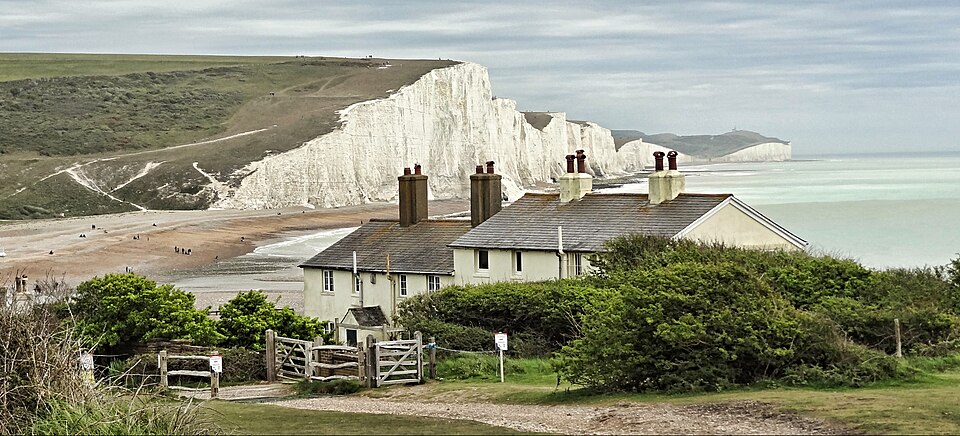
The Seven Sisters walk crosses a succession of white chalk cliffs between the Cuckmere Valley and Eastbourne. It is one of England’s great coastal days: beautiful, exposed and considerably hillier than photographs tend to confess.
Seven Sisters walk at a glance
| Classic route | Seaford to Eastbourne |
|---|---|
| Distance | Roughly 13–14 miles depending on variations |
| Difficulty | Hard, with repeated steep climbs |
| Time | Six to eight hours for many walkers |
| Transport | Rail at Seaford and Eastbourne; buses along the coast |
Which direction should you walk?
Walking west to east from Seaford gives the classic approach through the Cuckmere Valley, over the Seven Sisters and onwards past Belle Tout towards Beachy Head and Eastbourne. Finishing in a town provides food, trains and the comforting knowledge that civilisation has not entirely abandoned you.
The reverse direction is equally valid and may suit wind direction or transport. Check the forecast before deciding: a strong headwind across exposed cliffs can turn a demanding walk into a long negotiation.
Seaford to Cuckmere Haven
From Seaford, the route climbs towards Seaford Head before descending towards Cuckmere Haven. This elevated section provides the famous view of the Coastguard Cottages beneath the chalk cliffs.
Stay well back from all cliff edges. Chalk collapses without warning, especially after rain, frost or prolonged dry weather. The cliffs are magnificent, but they are not remotely sentimental about visitors. A grassy lip is not evidence of solid ground beneath it.
Crossing the Cuckmere
The safe standard route follows paths inland to cross the River Cuckmere by bridge near Exceat before returning towards the coast. Do not attempt to wade the river mouth; depth, current and tide make it dangerous.
The meanders, grazing marsh and birdlife justify the inland loop. Treat it as part of the walk rather than an administrative inconvenience inserted between viewpoints.
Over the Seven Sisters
The named cliffs rise and fall in quick succession. The path is obvious in clear conditions, but each descent is followed by another climb. Pace yourself from the beginning and carry enough water, because shade and facilities are limited.
Rain makes chalk and grass slippery. Strong wind can affect balance near exposed ground. If conditions are poor, use lower inland paths or shorten the day using bus stops around Exceat and Birling Gap.
Birling Gap
Birling Gap provides toilets, refreshments when open and access to the beach via steps. Coastal erosion has removed several former coastguard cottages here and continues to reshape the cliffs.
Beach access depends on conditions and tides. Never stand beneath unstable cliff faces, and confirm that steps are open before building a plan around them.
Belle Tout and Beachy Head
The route continues past the Belle Tout lighthouse, which was famously moved inland in 1999 because erosion threatened its position. Beyond lies Beachy Head, the highest chalk sea cliff in Britain.
Beachy Head requires the same caution as the earlier cliffs: there are unguarded edges, sudden drops and potentially severe wind. Follow paths set back from the rim rather than the worn lines closest to it.
Descending to Eastbourne
From Beachy Head, paths descend towards Eastbourne and its seafront. The final miles can feel surprisingly long after the repeated climbs, so retain food, water and daylight rather than spending the entire supply at Birling Gap.
Eastbourne station lies inland from the coast. Allow time for the walk through town when choosing a train.
Shorter Seven Sisters options
Exceat to Eastbourne
Starting near the Seven Sisters Country Park removes the Seaford section while retaining the main cliffs, Birling Gap and Beachy Head. Confirm bus times before relying on this linear option.
Birling Gap circuit
A shorter circular walk around Birling Gap and the surrounding downs provides cliff views without completing the full route. It remains exposed and includes steep ground.
Cuckmere Valley walk
For poor weather or a gentler day, follow paths through the valley and around the meanders. You still see the chalk landscape without committing to every ascent.
Getting there without a car
Seaford and Eastbourne both have railway stations, making the complete walk naturally linear. Buses connect intermediate points including Exceat and East Dean, although frequency changes by season and day.
Check live timetables and identify two escape points before starting. A bus marked on an old blog post is not a legally binding promise.
What to carry
- Waterproof and windproof outer layer
- Walking shoes or boots with good grip
- Plenty of water and food
- Sun protection; the route is very exposed
- Offline map or paper map
- Headtorch outside the longest summer days
Use Rambl’s free hiking checklist and see our wider guide to England’s best autumn coastal walks.
Where to stay
Seaford is quieter and well placed for an early start. Eastbourne has the largest selection of hotels, restaurants and transport. Alfriston offers a countryside base inland, while East Dean places you close to Beachy Head and Birling Gap.
Accommodation near the route creates natural scope for future hotel partnerships, particularly for walkers arriving by train and completing the trail over two gentler days.
Explore England’s coast on foot
Find quieter beaches, cliff paths and village bases through Rambl’s growing collection of coastal walks.
See more coastal walks