Black Shuck
The Hellhound That Haunts the Suffolk Coast
If you see him once, they say, you’ll be dead within the year.
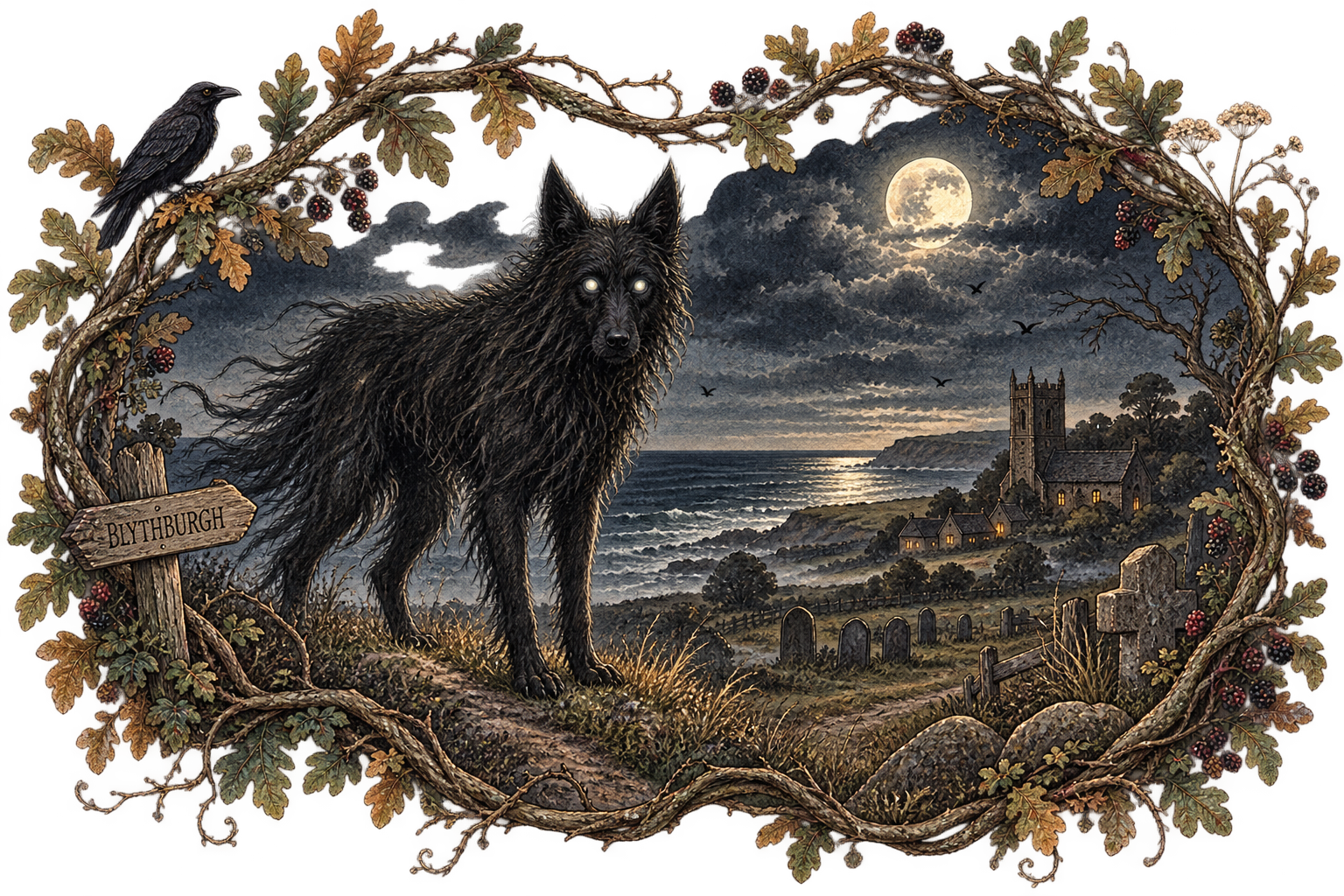
England has a great many ghost stories, but only a handful of them come with scorch marks you can still go and touch. Black Shuck’s do. He’s East Anglia’s own hellhound, a huge black dog with eyes like burning coals, said to roam the coast, the lanes, the churchyards and the marshes of Norfolk and Suffolk for as long as anyone can remember. Meet him on a lonely road at night, the story goes, and you’ll be dead within the year. Some tellings are kinder, a silent companion who walks beside lone travellers and leaves them safely at their door. Shuck was never terribly consistent about which mood he’d be in.
What makes him different from most folklore beasts is that his most famous appearance isn’t vague or unplaceable. It happened on a specific afternoon, in a specific town, in front of a congregation who wrote it down.
The Day Shuck Came to Church
On 4 August 1577, a violent storm broke over Bungay in Suffolk, the kind of thunder and lightning a contemporary account called unlike anything seen before. Inside St Mary’s Church, the congregation was sheltering from the weather when, according to the story, a huge black dog burst through the doors on a crack of thunder, tore through the nave, and left two worshippers dead before vanishing as suddenly as it arrived.
The same afternoon, twelve miles away at Holy Trinity Church in Blythburgh, it happened again. The dog is said to have crashed in mid-service, killed two more people, and struck the steeple hard enough to bring it down through the roof. As it left, it dragged its claws down the north door on the way out.
The account comes from a pamphlet by Reverend Abraham Fleming, printed the same year, titled with the kind of restraint the sixteenth century was famous for: “A Straunge and Terrible Wunder.” Fleming wasn’t there himself, he was working from secondhand reports, so precisely how much of it is eyewitness testimony and how much is Tudor embellishment is anyone’s guess. Church records do confirm a genuinely severe storm that day, and two deaths at Bungay. Whether a hellhound was involved, or whether panicked parishioners caught in a lightning strike simply needed somewhere to put the blame, is the question that’s kept the story alive for four centuries.
What’s Actually True (Probably)
The name Shuck likely comes from the Old English “scucca,” meaning demon or fiend, which tells you the people naming him weren’t in much doubt about what they thought he was. Black dog legends exist right across the British Isles, Wales has its own version, the Gwyllgi, and the phrase “black dog” itself later became shorthand for depression, borrowed centuries on by Samuel Johnson and later Winston Churchill, though that’s a separate thread of folklore entirely, nothing to do with Shuck himself.
The steeple collapse at Blythburgh is genuinely documented, storm damage to a church roof is exactly the kind of thing that gets written down and repaired at real expense, so there’s little reason to doubt that part happened. The more mundane explanation for the door marks is a lightning strike scorching the wood rather than a supernatural claw, which is a rather less exciting but considerably more plausible bit of sixteenth century structural damage.
Whatever the truth of 1577, Black Shuck outgrew that single afternoon a long time ago. Sightings have been reported up and down the Norfolk and Suffolk coast for centuries since, and the dog remains a fixture of local identity rather than a historical footnote, Bungay’s own coat of arms features him, and the town hall weathervane, fittingly, keeps getting struck by lightning.
He’s also had a rather more famous afterlife than most local legends manage. Arthur Conan Doyle is widely believed to have drawn on East Anglian black dog stories, Shuck among them, when he sat down to write The Hound of the Baskervilles, which is as good a measure as any of how far a good ghost story can travel from a Suffolk churchyard.
Visiting Bungay and Blythburgh
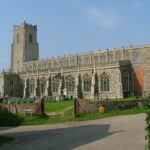
Both towns sit in the Suffolk countryside, roughly twelve miles apart, easily combined into one day if you fancy following the dog’s supposed route. Holy Trinity Church in Blythburgh is open to visitors and the north door with its scorch marks is very much still there to see, a genuinely striking, atmospheric building even without the legend attached. St Mary’s in Bungay is equally worth the stop, and the town leans into its most famous resident properly, Shuck turns up on local signage, in shop names, and at the town’s own festival celebrating its folklore heritage.
It’s flatter, quieter walking country than the fells and stone circles this site usually covers, more marsh and reed-bed than mountain, but that low, wide East Anglian light has its own particular atmosphere, especially as the evenings draw in.
FAQs
Is Black Shuck real?
There’s no credible evidence of a supernatural dog roaming East Anglia. What is genuinely documented is a severe storm at Bungay and Blythburgh in 1577, two recorded deaths, and real structural damage to Blythburgh’s church steeple. The claw marks are more likely scorching from a lightning strike than anything else.
What does Black Shuck look like?
Accounts describe a huge, shaggy black dog roughly the size of a calf, with eyes that glow or burn red, sometimes said to be a single central eye. Some versions have him silent and almost gentle, others violent and monstrous, the legend was never especially consistent on temperament.
Where can I see the claw marks?
On the north door of Holy Trinity Church in Blythburgh, Suffolk. The church is open to visitors and the scorched grooves, locally nicknamed the Devil’s fingerprints, are still clearly visible.
Is Black Shuck connected to Sherlock Holmes?
Indirectly, yes. Arthur Conan Doyle is widely thought to have drawn on East Anglian black dog folklore, Shuck included, when writing The Hound of the Baskervilles.
Long Meg’s witches were turned to stone, gently, as these things go. Pendle’s story ended in a courtroom and a set of gallows. Shuck’s is stranger still, a story that never really resolved either way, a dog that’s been seen, or not seen, up and down the same stretch of coast for four hundred years, with nothing to show for it but a scorched door and a shiver on a dark lane. Our pieces on Long Meg and Her Daughters and the Pendle Witches cover two very different kinds of English folklore, worth a read if this one’s left you wanting more. For further reading, our folklore archive and history section are worth a browse too.