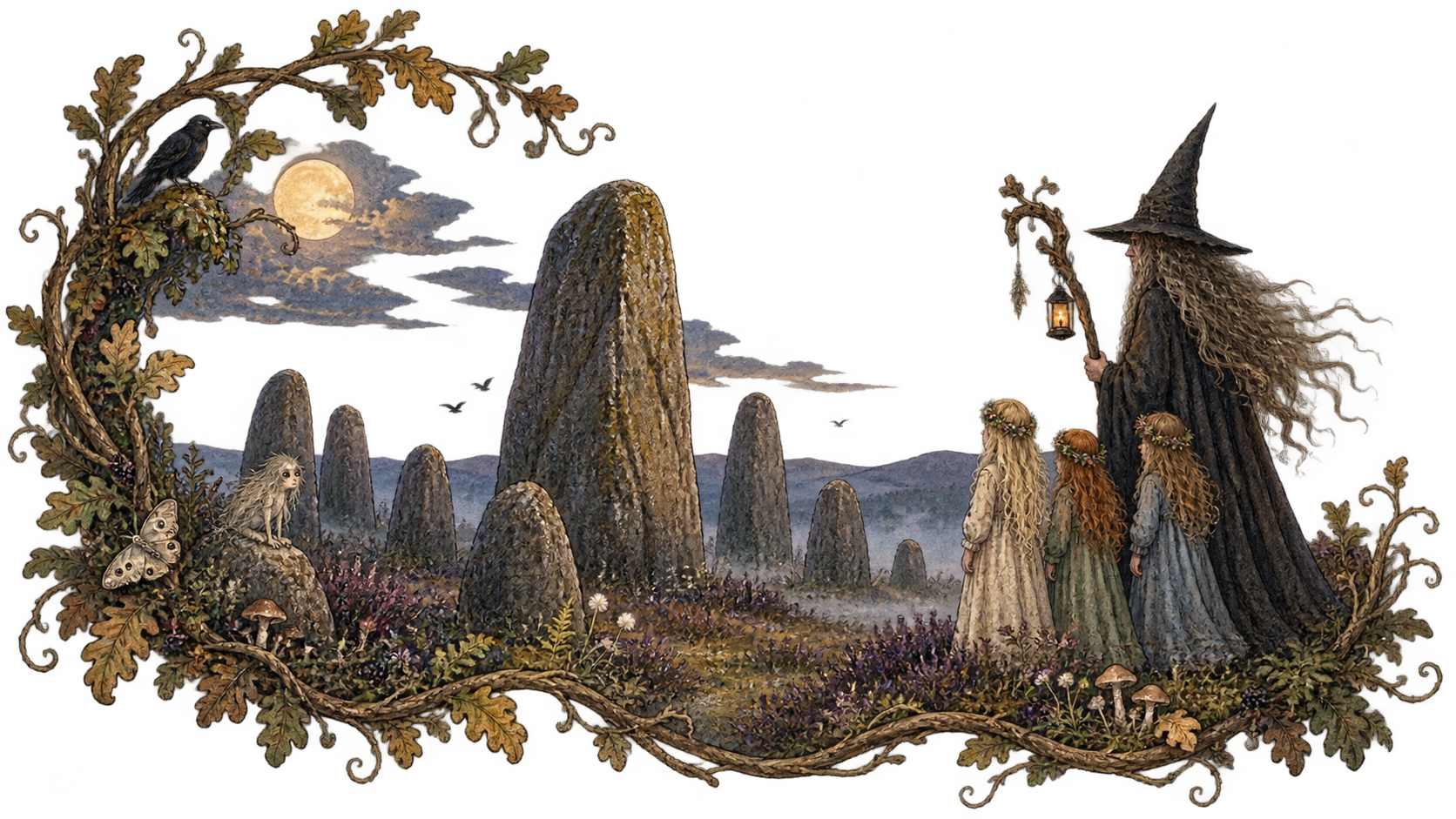
Long Meg and Her Daughters
Cumbria’s Stone Circle of Petrified Witches
Try counting the stones. Go on. I’ll wait.
Just outside the village of Little Salkeld, on a quiet stretch of farmland above the River Eden, there’s a stone circle that’s been quietly unsettling visitors for roughly four thousand years. It’s the second largest stone circle in England, after Avebury, and by most accounts a serious contender for one of the most atmospheric. It’s also, according to several centuries of local storytelling, a coven of witches who got caught dancing on a Sunday and never really recovered from it.
Nobody comes here for the car park. There isn’t one, not really, just a farm track and a gate and the sort of walk that makes you feel like you’ve earned the view. Which, once you’re standing among the stones with Cumbria rolling off in every direction, you rather have.
At a Glance
- Where: Near Little Salkeld, close to Penrith, Cumbria
- Age: Neolithic to early Bronze Age, somewhere around 4,000 years old
- Size: Around 100 metres across, second only to Avebury in England
- Stone count: Depends who’s counting, and according to legend, that’s rather the point
- Cost: Free, and open all year round
The Legend of the Dancing Witches
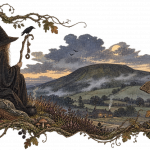
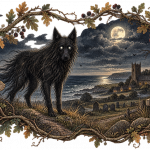
The story goes that Long Meg was a witch, sometimes named as Meg of Meldon, and the smaller stones scattered around her were her daughters or her coven, depending on which version you’re told. They were caught holding a sabbat on the moor, dancing when they really ought to have been observing the Sabbath, and a travelling Scottish wizard by the name of Michael Scot took considerable offence. He turned the lot of them to stone on the spot, and there they’ve stood ever since, mid-dance, presumably still faintly embarrassed about it.
The circle comes with its own built-in security system. Local tradition holds that the stones can never be counted twice and arrive at the same number, and if you ever do manage it, the spell breaks and the witches come back to life. Given how many people have tried and how few reports there are of a coven rampaging across Cumbria, either the magic is holding firm, or everyone keeps losing count somewhere around forty, which, if you’ve ever tried counting sheep in a field with your in-laws talking over you, is entirely believable.
Long Meg’s witches were, as far as anyone can tell, entirely fictional, turned to stone by an angry wizard rather than facing anything resembling a real trial. Not every English witch story ends so gently. Our piece on the Pendle Witches covers a case where the accusations, and the consequences, were horribly real.
Long Meg stands apart from the circle itself, a red sandstone pillar over three and a half metres tall, carved with a spiral and a set of cup-and-ring markings that have been quietly weathering away for thousands of years. From certain angles, people have long claimed you can make out the profile of a face in the stone. Whether that’s a witch mid-transformation or simply what happens when the human brain spends too long staring at rock formations is, admittedly, a matter of personal conviction.
What’s Actually True (Probably)
Strip away the witches and the circle is still genuinely remarkable. It likely dates from the late Neolithic or early Bronze Age, making it older than Stonehenge in its current form, and archaeologists believe it was used as a gathering place for ceremonies or seasonal rituals rather than anything resembling everyday life. The alignment is the detail that tends to convert the sceptics: stand in the right spot at midwinter, and Long Meg lines up with the setting sun on the shortest day of the year, which is either a remarkable coincidence or evidence that Bronze Age Cumbrians were considerably better at astronomy than most of us are at reading a bus timetable.
The “daughters” themselves are geologically a mixed bunch, boulders dragged from as far as Scotland and the Lake District fells, quite unlike the local sandstone Meg herself is carved from. Which raises the rather practical question of how anyone without a Land Rover moved multi-tonne rocks across Cumbria several thousand years before the invention of the wheelbarrow. Nobody’s entirely sure. Wordsworth, for what it’s worth, was thoroughly taken with the place and rated it as highly as Stonehenge, and Wordsworth was not a man given to casual enthusiasm about rocks.
The Exploding Farmer Postscript
In 1725, a local landowner named Colonel Lacy decided the stone circle was taking up perfectly good farmland and set about having it blown apart with explosives to clear the ground. Partway through the job, a sudden and violent storm rolled in out of nowhere, and the labourers, thoroughly spooked, downed tools and refused to go anywhere near the place again. Whether that was genuinely supernatural intervention or simply Cumbrian weather doing what Cumbrian weather does is, again, a matter of where you personally stand on these things. Either way, Long Meg and her daughters are still there, and Colonel Lacy’s farmland improvement scheme is not.
Getting There (Without Losing the Will to Live)
The circle sits just outside Little Salkeld, a short drive from Penrith, and it’s free to visit year round with no ticket office, gift shop, or anyone checking your name against a list. Park considerately near the village and follow the signposted footpath across the field, it’s a gentle walk rather than a proper hike, easily doable in normal shoes, though it does the job better in the rain and mud that Cumbria specialises in.
If you fancy making a proper afternoon of it, Little Meg, a much smaller and quieter circle, sits about half a kilometre to the north-east, and the walk between the two is a pleasant way to stretch the visit out. If you’re planning a proper walking day around it, the UK Walks Map will help you build a route.
FAQs
How many stones are there really?
Estimates generally sit somewhere between fifty and seventy, with a good number fallen, buried, or removed over the centuries. Given the legend attached to counting them, we’d argue the ambiguity is doing exactly what it’s supposed to.
Is Long Meg haunted?
There’s no specific ghost attached to the site beyond the witch legend itself, though the atmosphere at dusk does a fairly convincing job of making you reconsider the question.
Is it free to visit?
Yes, entirely free, with open access across the field on the public footpath. There’s no visitor centre, so bring your own context, or read this first.
Can I combine it with a Lake District walk?
Easily. It sits close enough to Penrith and the A66 corridor to work as a detour on the way into or out of the Lakes, rather than needing a dedicated trip of its own.
Whatever you make of the witches, there’s something genuinely humbling about standing in a field that people have been gathering in for four thousand years, for reasons we can only guess at, built by people using tools considerably less advanced than the ones currently in your pocket. Long Meg has outlasted Roman occupation, Colonel Lacy’s dynamite, and several centuries of people confidently miscounting her daughters. She’ll very likely outlast the rest of us too.