Helvellyn via Striding Edge: The Route, the Risk, and the Dog Who Wouldn’t Leave
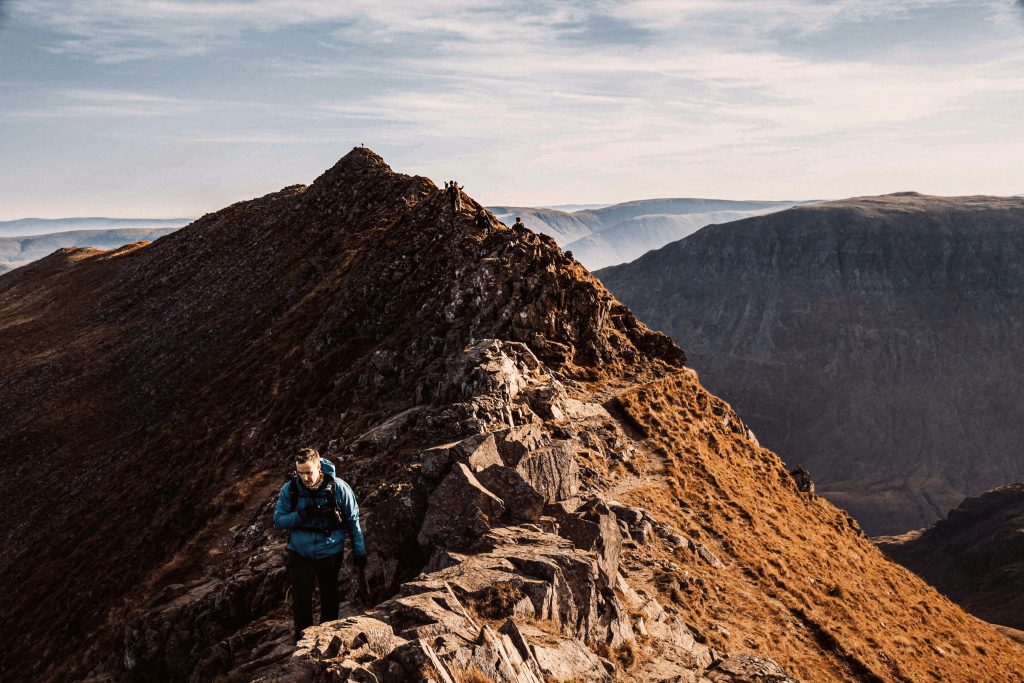
Helvellyn is the third-highest mountain in England, and Striding Edge is the reason most people climb it. It’s a narrow, exposed ridge that turns a hill walk into something closer to an adventure, and it’s also the site of one of the Lake District’s most genuinely affecting true stories: a young painter who never came down, and the dog who stayed with him for three months until someone found them both.
This guide covers the walk itself, properly, and the story that goes with it. Not because folklore needs padding out with a fitness plan, but because the two belong together. You’ll walk straight past the spot the story happened.
Quick Facts
- Distance: around 8 miles (13km) via Striding Edge up, Swirral Edge down. Add Catstye Cam and you’re closer to 12.5km.
- Ascent: roughly 950m
- Time: 5 to 6 hours, depending on conditions and how long you linger at the top
- Difficulty: hard. Striding Edge is a Grade 1 scramble, low on the scramble scale but not to be underestimated
- Start point: Glenridding, Cumbria (CA11 0PA), pay-and-display parking
- Map: OS Explorer OL5, The English Lakes North Eastern Area
The Route
Glenridding to the ridge
The walk begins gently enough. From Glenridding, you follow Mires Beck up through the Hole in the Wall stile, and the path steadily steepens as Red Tarn comes into view below you. This part is straightforward hill walking. Save your nerves for what comes next.
Crossing Striding Edge
This is what you came for. The ridge itself is around 300 to 400 metres of narrow, rocky arête, in places only two or three metres wide, with a serious drop on both sides. You’ll need your hands as well as your feet for some of it. Towards the end there’s a short downclimb known locally as the Chimney, a drop of five or six metres where you’ll be lowering yourself down on handholds.
None of this requires climbing experience. It does require calm nerves, dry rock, and reasonable weather. In poor visibility, high wind, or ice, Striding Edge stops being a Grade 1 scramble and starts being a genuinely dangerous place, and people do still get caught out here most years. If conditions look marginal, there’s no shame in walking up via the easier path and skipping the ridge entirely.
Summit and the way down
From the top of the ridge, a steep final pull takes you to Helvellyn’s summit. Most walkers descend via Swirral Edge, which is also a Grade 1 scramble but shorter and less sustained than Striding Edge, before dropping back down past Red Tarn to Glenridding.
A quick honest note on safety: this is not a beginner’s walk. Build up some hill and scrambling experience before attempting it, go in good weather, and consider crampons and an axe if there’s any snow or ice about. It’s easy to underestimate because the grade is low, and that’s exactly how people get into trouble on it.
If you’re after something less exposed and more beginner friendly, read our guides to Catbells or Derwentwater.
The Story of Charles Gough and Foxie
In April 1805, a 21-year-old painter named Charles Gough set out from Patterdale to walk over Helvellyn to Grasmere, planning to fish along the way. He’d asked for a guide, but the local militia were all busy with a review day, so he went alone, taking only his small terrier, Foxie, for company.
He never arrived. Nobody seems to have gone looking for him.
Three months later, in July 1805, a shepherd on the fellside heard a dog barking near Red Tarn. He found Foxie beside the skeletal remains of her master. Gough appeared to have fallen from the ridge, his hat split in two, consistent with a fall from Striding Edge itself.
What makes the story remarkable isn’t really Gough’s death. Falls happen, then and now. It’s that Foxie had survived three months alone on the mountainside, through snow and storms, and had somehow given birth to a puppy up there, which didn’t survive. How she fed herself for that long remains genuinely unexplained.
Legend versus record
Here’s where the story gets complicated, in the way these things usually do once you look past the plaque. A Carlisle newspaper at the time reported a rather less romantic version of events: that the dog had, in fact, been feeding on the body. Other reports at the time suggested ravens were responsible for the state of the remains instead.
The gentler version, the loyal dog keeping faithful vigil, is the one that stuck, and it’s the one three of the era’s biggest names put into print. Walter Scott wrote of climbing “the dark brow of the mighty Helvellyn.” Wordsworth wrote an entire poem, Fidelity, about the dog’s devotion. Edwin Landseer painted the scene. None of them were there. All of them were writing at the height of the Romantic movement, when a faithful dog guarding its master’s body was exactly the kind of image the age wanted.
Whether Foxie kept a loyal vigil or simply did what a starving animal does is a question nobody alive can answer with certainty. Worth knowing both versions exist, rather than only the one that makes a better plaque.
A memorial stone was erected on the ridge in 1890, inscribed simply: beneath this spot were found in 1805 the remains of Charles Gough, killed by a fall from the rocks. Gough himself is buried in the Quaker graveyard at Tirril.
What to Look Out For
- The memorial stone, set into the ridge near where Gough is believed to have fallen. Easy to miss if you’re concentrating on your footing, which, fairly enough, you probably should be.
- Red Tarn, directly below the ridge, where Foxie was eventually found.
- Catstye Cam, visible from the ridge and worth the short detour if you’ve got the legs left for it on the way down.
If Charles Gough’s story has left you in the mood for more of Cumbria’s stranger tales, our look at Long Meg and Her Daughters covers a rather different kind of local legend, a coven of witches turned to stone rather than a loyal dog.
FAQ
Is Striding Edge dangerous? In good conditions, for a reasonably fit and confident hill walker, it’s a manageable scramble. In poor weather or ice, it becomes genuinely hazardous, and people are caught out on it most years. Check the forecast properly before you commit.
Do I need scrambling experience? Not technical climbing experience, but some hill-walking miles under your belt first is sensible. This isn’t the walk to learn your nerve on.
Can beginners do this walk? Honestly, no, not as a first hike. There’s a gentler path up Helvellyn avoiding the ridge entirely if you want the summit without the exposure.
Is the Charles Gough memorial easy to find? It’s a small stone set into the ridge itself, not signposted, so keep an eye out around the section where the ridge narrows most.
If you’re heading out on a walk like this and want the shorter version of everything worth knowing before you go, the Rambl Hikers Guide covers weather, kit, navigation and rights of way in one place, written properly rather than scraped together.
More from Rambl
Join the Rambl list for useful UK walks, countryside ideas, wild-camping advice and gear guides. No daily inbox assault.