Last reviewed and updated: October 2026.
Nobody thinks much about walking trousers until about an hour into a damp walk, when ordinary trousers become cold, clingy and strangely determined to remind you of their existence.
For most British countryside walking, I would rather have stretchy, quick-drying walking trousers plus waterproof overtrousers in the bag than one heavy waterproof pair worn all day. It is a less heroic approach to outdoor clothing, but usually a more comfortable one.
How this guide was researched: the recommendations below use current manufacturer specifications and are aimed at ordinary UK walking rather than technical mountaineering. Rambl does not claim personal testing where it has not happened. See our editorial standards.
Three sensible options
| Product | What it is | Best fit |
|---|---|---|
| Craghoppers Kiwi Pro II | Stretch walking trouser with water-repellent finish | One general-purpose pair |
| Quechua MH500 | Light synthetic stretch walking trouser | Budget and warmer-weather walking |
| Quechua MH500 waterproof overtrousers | 3-layer waterproof shell trouser | Carrying for sustained rain |
Craghoppers Kiwi Pro II: the all-round research pick
The current Kiwi Pro II uses a 96% polyamide / 4% elastane main fabric with Craghoppers’ H2OShield water-repellent finish. It is an active-fit trouser with stretch, a partly elasticated waist and fabric rated for UV protection.
The key word is water repellent, not waterproof. That is exactly why it makes sense as an everyday walking trouser: enough protection for damp grass and passing drizzle without turning your legs into a boil-in-the-bag experiment. Proper rain still calls for a shell layer.
- Good fit for: mixed UK walking through much of the year
- Less ideal for: sustained heavy rain without overtrousers
Quechua MH500: the budget choice
Decathlon’s current men’s MH500 uses a lightweight synthetic fabric with 15% elastane, pre-shaped knees, a removable belt and four zipped pockets. Decathlon explicitly lists it as not waterproof and not windproof, which is refreshingly useful information rather than something to hide in the small print.
For spring, summer and autumn walks where freedom of movement and quick drying matter more than weatherproofing, it is difficult to argue with the basic proposition. It is also cheap enough that somebody starting walking does not need to buy expensive technical trousers before discovering whether they actually enjoy hills.
- Good fit for: budget-conscious walkers, milder weather and active walking
- Less ideal for: cold exposed days or persistent rain
Quechua MH500 waterproof overtrousers: the rain layer
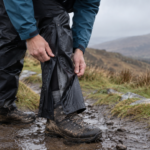
This is the other half of the system. Decathlon lists the current MH500 overtrousers with a 15,000mm three-layer waterproof membrane, a breathability figure of 10,000g/m²/24h and a weight around 354g in size L. The side zips rise above the knee so they can be pulled on without taking boots off.
That is much more useful than wearing a waterproof trouser from breakfast because the forecast shows a cloud at 3pm. Carry them, pull them on when the rain actually settles in, and take them off when it stops.
- Good fit for: longer walks and genuinely wet forecasts
- Less ideal for: wearing all day in mild dry weather
What matters more than the brand?
Stretch. Stiles, steep steps and awkward ground are much nicer when the trousers move with you.
Drying time. In Britain, “not waterproof” is perfectly manageable if the fabric dries quickly and you have a shell for proper rain.
Fit. Trousers that bunch behind the knee or pull at the thigh will become irritating long before a missing technical feature does.
Pockets you can actually use. Deep zipped pockets beat six tiny decorative ones. Nobody wants to donate a car key to a Peak District path.
Do you need waterproof walking trousers?
Usually, I would say you need access to waterproof trousers, not necessarily waterproof trousers on your legs all day. Quick-drying walking trousers are more pleasant in mixed conditions. A lightweight shell in the backpack deals with the weather when it becomes serious.
If you only walk short, easy routes and can simply go home when the heavens open, you may rarely use overtrousers. For longer exposed walks, they are a much more sensible backup.
What about jeans?
For a dry village stroll, wear whatever you like. For a longer countryside walk where rain is plausible, jeans are a poor bargain: cotton holds water, becomes heavy and takes a long time to dry.
You do not need to dress like you are crossing Greenland. You just need fabric that does not become a cold wet towel because a footpath went through knee-high grass.
Which would I buy?
- One general walking trouser: Craghoppers Kiwi Pro II.
- Keeping the cost down: Quechua MH500.
- For actual rain protection: carry the MH500 waterproof overtrousers over either.
Those are editorial recommendations based on the current published designs and specifications, not claims of side-by-side personal testing.
Before buying
Try the trousers while bending a knee, stepping up and sitting down. Walking clothing should disappear once you are moving. If you are thinking about the waistband every ten minutes in the changing room, it is unlikely to become charming on mile eight.
For the rest of the layering system, see what to wear hiking in the UK and our guide to walking shoes for British paths.